
AI Music Detectors Explained: Can They Really Tell If a Song Was Made With AI?
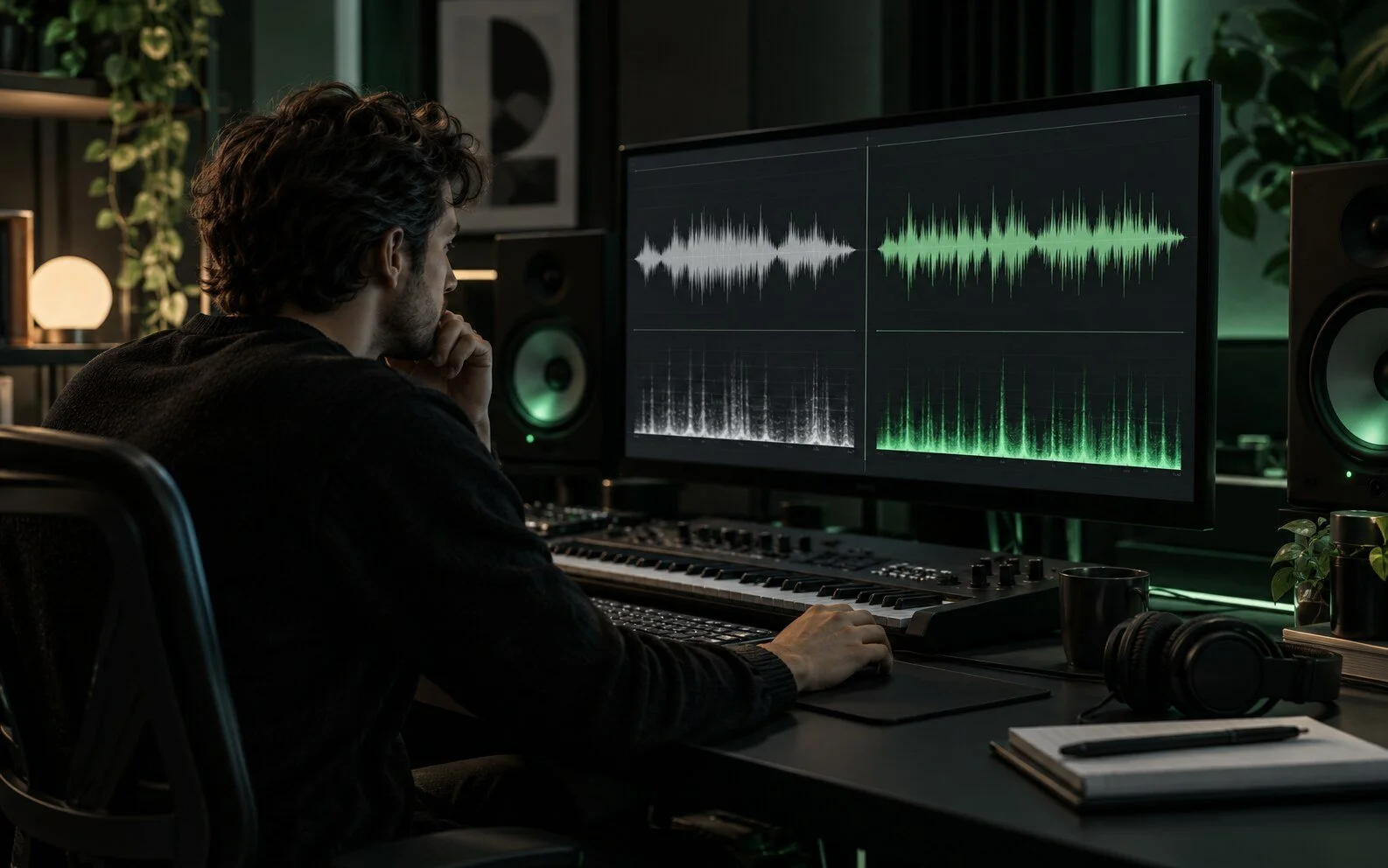
An AI detector can flag patterns in audio, but its score still requires context.
AI music detectors are becoming the new metal detectors at the entrance of the streaming economy. Labels, distributors, platforms and listeners increasingly want a fast answer to a difficult question: was this track made by a person, generated by a model, or assembled from both?
The pressure is understandable. On July 21, 2026, Deezer said fully AI-generated music had exceeded 50 percent of the daily tracks delivered to its platform during June, peaking at roughly 90,000 uploads in one day. Yet the same company reported that these tracks represented only a small share of listening—and that fraudulent activity shaped a large portion of those streams.
An AI music detector can help manage that volume, but it cannot read a song’s biography. Its output is an estimate based on patterns. For artists, the smartest response is to understand what those tools can do, where they fail and how to build stronger proof of a track’s creative history.
What an AI Music Detector Actually Measures
A detector analyzes features in an audio file and compares them with patterns learned from examples of human-made and AI-generated material. Depending on the system, those clues can include spectral texture, timing regularity, vocal artifacts, repeated structures, frequency relationships or signatures associated with particular generation models.
That process is different from identifying a watermark or reading a verified production record. A model may return a percentage or a label such as “likely AI,” but the number is not a direct measurement of how much human creativity is inside the song. It reflects the detector’s confidence under its own design and training data.
Deezer says it has built technology capable of identifying fully AI-generated music from widely used models and uses that system to label such tracks and remove them from algorithmic recommendations. That is a platform-scale moderation decision, not proof that every public detector can deliver the same accuracy.
Why a Detector Result Is a Probability, Not a Verdict
Music is unusually difficult to classify because ordinary production already contains machine-assisted elements. Quantized drums, tuned vocals, sample libraries, mastering limiters, virtual instruments and stem separation can all leave patterns that look synthetic. Meanwhile, a generated recording can be edited, re-recorded, mixed with live performances or processed until its original signature becomes harder to recognize.
A detector may also perform well on the models included in its training set and struggle with a new generator, a niche genre or a heavily compressed upload. That creates two familiar risks: a false positive that labels human work as AI, and a false negative that clears generated material.
For that reason, a score should trigger investigation, not end it. Repeating the test on a lossless file, checking whether the tool identifies the model families it supports and comparing results across more than one credible system can provide context. None of those steps turns probability into authorship evidence.
The Upload Itself Can Create a New Risk
Before placing an unreleased master into a free web detector, read its privacy policy and terms. Artists should know whether the file is stored, shared, used to improve a model or deleted after analysis. An unclear upload policy is a poor trade for a colorful percentage score.
Use a short excerpt or a non-final bounce when that is sufficient, and avoid uploading stems or sensitive client work without permission. Labels and producers should establish an approved tool list rather than allowing every collaborator to send unreleased material to unknown services.
This is especially important when a recording contains confidential features, uncleared samples or material governed by a work-for-hire agreement. Detection should not create a separate rights-management problem.
Provenance Is Stronger Than Guesswork
The better long-term approach is provenance: reliable information about where a file came from and how it changed. The Coalition for Content Provenance and Authenticity, or C2PA, maintains an open technical standard for recording the origin and edit history of digital content through Content Credentials. Adoption is still developing across audio workflows, but the principle is useful now.
Keep dated session files, raw vocal takes, MIDI performances, lyric drafts, stem exports, producer agreements and revision notes. Preserve distributor delivery confirmations and the final master checksum when possible. These records show a creative process instead of asking an outside classifier to infer one from the finished waveform.
If AI tools were used, document the tool, purpose, inputs and amount of human revision. Honest records make it easier to answer questions from collaborators, licensors and distributors later.
Disclosure Rules Still Matter
Platforms are approaching synthetic media through both detection and disclosure. YouTube requires creators to disclose realistic altered or synthetic content in specified circumstances and may add labels itself when viewers could otherwise be misled. Music-specific policies vary by service and can change, so release teams should check the current rules before delivery.
Disclosure does not mean every compressor, noise remover or tuning plug-in needs a warning. The meaningful question is whether synthetic generation or alteration could cause an audience to misunderstand who performed, spoke or created the material.
Artists using new production tools should add platform-policy review to the same checklist as credits, splits and metadata. The Uranium Waves Music Release Planner can help keep those steps attached to the campaign instead of leaving them for release night.
How Artists Can Protect Their Work
Build a simple evidence folder for every release. Include project files, dated rough mixes, contracts, consent records, source information for licensed samples and a note explaining any generative tools used. Export a lossless archival master and keep backups in two locations.
If a distributor or platform flags the track, ask what evidence it accepts and respond with documentation—not only a screenshot from another detector. For collaborators, put disclosure and approval duties into the agreement before the session begins.
Technical quality matters too. A clean master will not prove human authorship, but it reduces the artifacts that invite avoidable questions. The Master Loudness Checker can help artists review a final export, while Uranium Waves’ guide to AI advertising tools in music marketing explores a separate part of the AI workflow.
Final Takeaway
AI music detectors are useful screening tools, especially when platforms must evaluate uploads at industrial scale. They are not lie detectors for creativity.
Treat every score as one signal among several. Protect unreleased audio, understand the detector’s limits, follow platform disclosure rules and preserve the records that explain how the song was actually made. In a market flooded with synthetic content, a trustworthy creative trail will matter more than a single percentage on a screen.
Enjoyed the read? Consider showing your support by leaving a tip for the writer
Featured








Follow Us

Shop















Wendy Bruner and Christopher Grundy construct “Toward Shalom” around warmth rather than spectacle, allowing its ideas of belonging, completeness, and social acceptance to develop inside an intentionally unvarnished frame. Written by Bruner and Monty Jackson and produced…