
How to Build an Emergency Fund When Music Income Is Unpredictable
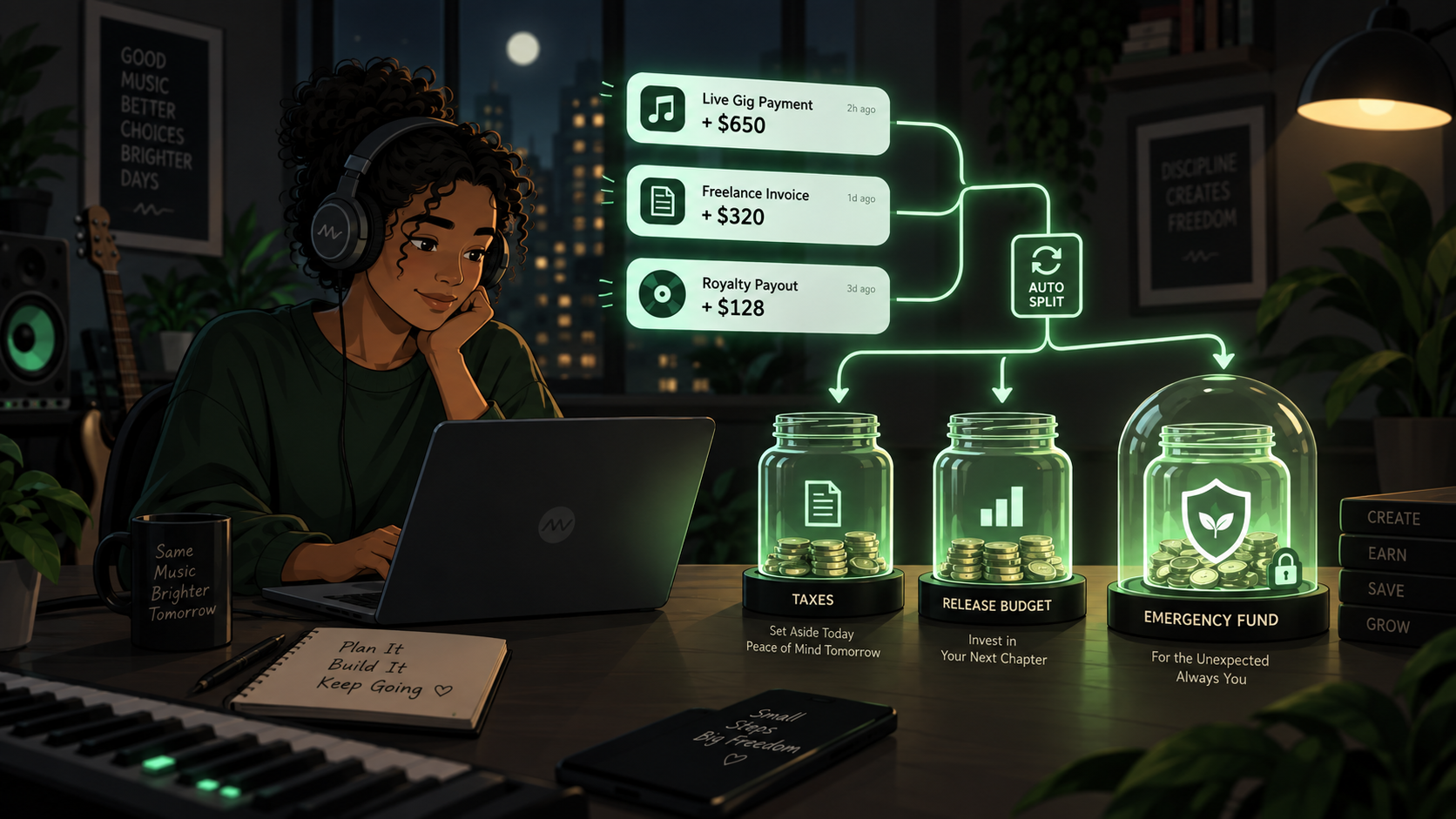
Music income rarely arrives with the rhythm of a salary. A performance fee may land on Friday, a freelance invoice two weeks late and a royalty payment once a quarter. The next month can be quiet even while the artist appears busy online.
That volatility makes an emergency fund more important, not less. Without a reserve, one broken laptop, cancelled contract or urgent dental bill can force an artist to use high-interest debt, sell essential equipment or redirect the budget for an upcoming release. The aim is not to predict every crisis. It is to create enough accessible cash that an unexpected expense does not immediately become a career emergency.
Define What Counts as an Emergency
An emergency is necessary, urgent and unplanned. A rent shortfall after cancelled work, critical car repair for a touring musician or replacement of a failed production computer may qualify. A spontaneous music video upgrade, festival trip or discounted synthesizer does not. Create a written rule before the money is needed. That reduces the temptation to treat a reserve as a general opportunity fund. Musicians can also benefit from separating two risks:
Personal emergencies: housing, food, utilities, medicine and essential transportation
Business continuity emergencies: equipment or services required to keep earning income
These reserves can live in separate accounts or in one account with clearly tracked sub-targets. What matters is knowing how much of the balance protects daily life and how much protects the operation.
Calculate an Essential Monthly Number
The Financial Consumer Agency of Canada says an emergency fund should ideally cover three to six months of regular expenses. Its budget guidance also emphasizes starting with a small regular amount when that larger target feels unreachable. For an artist with variable income, start with expenses rather than average revenue. List the monthly costs that cannot be paused safely:
Rent or mortgage
Basic food and household supplies
Utilities, phone and internet
Insurance and minimum debt payments
Medication and essential transportation
Core business software, website and distribution costs
Exclude optional promotion, entertainment and flexible purchases from the first calculation. If essential personal costs total $2,200 and critical business costs total $300, one month of protection is $2,500. Three months would be $7,500; six months would be $15,000. That range is a destination, not a judgment. A first milestone of $500 or one month of essential costs is already useful.
Build From the Income Floor, Not the Best Month
Average income can hide volatility. An artist who earns $4,000 one month and $1,000 the next has an average of $2,500, but fixed commitments based on that average may be difficult during the lower month. Review the last 12 months and identify the income floor: the amount reliably earned during weaker periods. Use that number to decide what fixed automatic contribution is sustainable.

Then add a percentage rule for stronger payments. For example, the artist might transfer a modest fixed amount every week and direct 10% of each performance fee, royalty payment or freelance invoice to the reserve. This system expands when income rises without creating an impossible obligation when work slows. The Government of Canada’s emergency-fund guidance recommends automating transfers and aligning them with paydays. Musicians can apply the same idea whenever money lands rather than relying on one monthly date.
Separate Taxes Before You Measure Progress
A $1,000 self-employed payment is not necessarily $1,000 of spendable income. Part may be needed for income tax, CPP contributions or sales-tax obligations, depending on the artist’s situation. Move tax money into its own account before calculating the emergency contribution. Otherwise, a balance can look reassuring while part of it already belongs to a future tax bill.
The reserve is also different from a release budget. Campaign money has an intended use; emergency money exists precisely because its use is unknown. Uranium Waves’ Music Release Planner can help isolate campaign commitments so they are not confused with protective savings.
Use a Tiered Target
A large goal becomes easier to build when it has stages:
Shock absorber: enough for one common urgent expense
One-month floor: essential personal and business costs for a month
Three-month reserve: stronger protection against a work interruption
Extended reserve: up to six months when income is highly volatile or dependants rely on it
The appropriate target depends on stability, insurance, debt, household income and access to other support. A musician with a salaried partner may choose differently from a full-time touring artist supporting a family.
Keep Emergency Money Boring
Emergency cash should be accessible, separate from daily spending and protected from unnecessary risk. The FCAC advises using an account that is easy to access, has low or no transaction fees, permits withdrawals without penalty and earns interest. Avoid treating volatile investments as the first line of emergency protection. A reserve may be needed when markets are down, and selling at that moment can deepen the problem. Name the savings account clearly. Hide it from the default debit card if the bank permits. The small amount of friction can prevent casual withdrawals without making genuine emergencies difficult to fund.
Create a Refill Rule
Using the fund for a real emergency is not failure. That is its purpose. After a withdrawal, record what happened, pause nonessential spending and restart the same transfer system. If the same “unexpected” cost appears repeatedly—annual software renewals, instrument maintenance or tax instalments—it belongs in a sinking fund or normal budget instead.
An emergency reserve works best beside separate accounts for taxes, planned releases and predictable annual costs. Each account answers a different financial question.
Final Takeaway
Musicians do not need perfectly predictable income to build financial protection. They need an essential-expense target, a contribution method that adapts to irregular payments and rules that keep the reserve separate from campaign spending. Begin with the first useful milestone, automate a realistic amount and add a percentage whenever stronger payments arrive. Over time, the fund becomes more than savings. It becomes negotiating space—the ability to reject a bad opportunity, survive a delayed invoice and protect the creative work from one unexpected bill.
This article provides general financial education, not individualized financial or tax advice.
Enjoyed the read? Consider showing your support by leaving a tip for the writer
Featured









Follow Us

Shop






















Some attractions arrive like a fever: quiet at first, then suddenly impossible to ignore. Greek-born, Brooklyn-based artist OXFLOYD captures that escalation on “obsessed w u,” an alt-pop single shaped around limerence, romantic fixation, and the dangerous appeal of willingly overlooking every warning sign…