
Music Distribution Deals Explained: Annual Fees, One-Time Fees and Revenue Shares
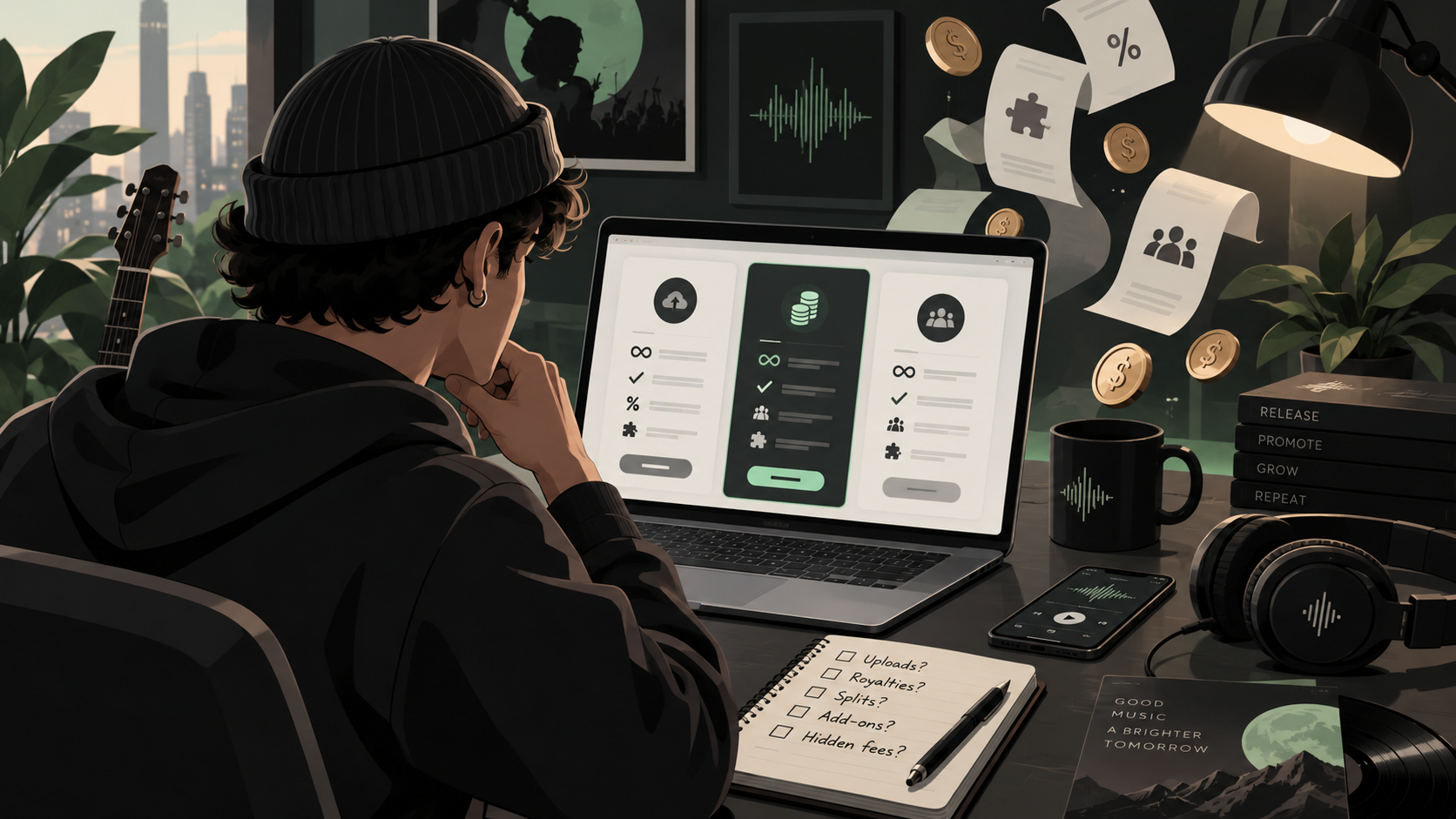
The headline on a music distributor’s pricing page is designed to make releasing feel simple: unlimited uploads, one small fee, keep your royalties. The real cost usually appears later, when an artist adds a second project, needs royalty splits, activates social-video monetization or stops renewing a plan.
There is no single cheapest distributor for every musician. A new artist earning very little may benefit from one fee structure, while a growing catalogue with meaningful revenue can reverse the calculation. Service scope matters just as much as price.
Understanding music distribution fees means looking beyond the upload charge. Artists should compare annual plans, one-time release fees, revenue shares, optional add-ons and the rules governing a catalogue after payment stops.
What a Distributor Is Actually Selling
A digital distributor delivers recordings and metadata to services such as Spotify, Apple Music and YouTube Music, then collects eligible revenue and reports it to the rights holder. Many distributors also offer tools for splits, pre-save pages, analytics, Content ID, publishing administration, cover-song licensing or label management.
Those extras are not interchangeable. A low entry price may exclude the feature you need, while a more expensive plan may bundle tools you would otherwise buy separately. Start by defining the job: how many artists, how many releases, which territories, what royalty workflow and what support level?
Use the Uranium Waves Music Release Planner to estimate your annual release volume before comparing plans. A distributor built for one single per year should be evaluated differently from one holding a 60-track catalogue.
Three Common Distribution Fee Models
An annual subscription charges every year for access to a plan. This can be attractive for frequent releases because the marginal upload cost may be low or zero. The risk is recurring dependence: artists must understand what happens to existing music if the subscription lapses and whether legacy options cost extra.
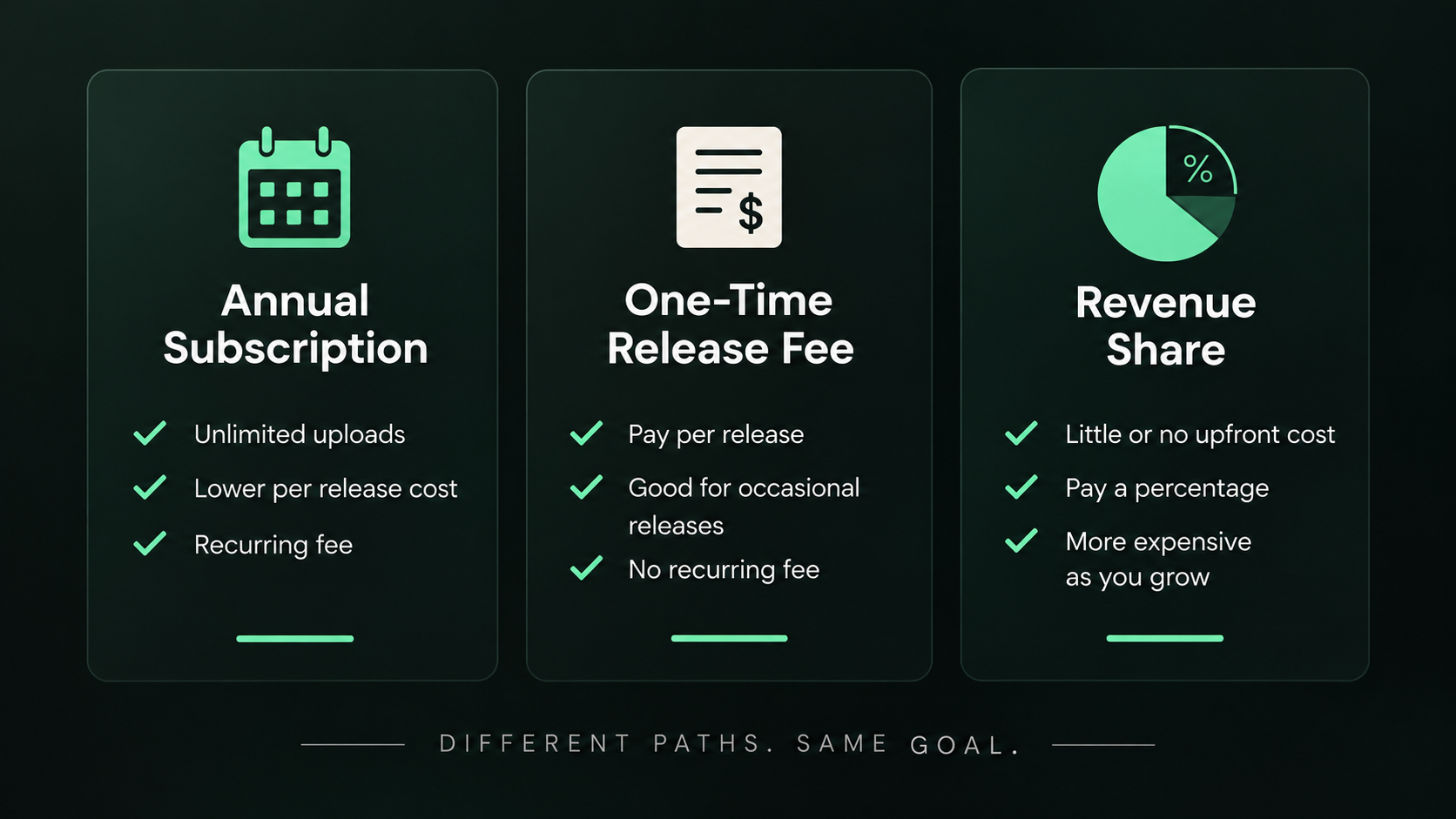
A one-time release fee charges for each single, EP or album. It can suit artists who release slowly and dislike another annual bill. However, a large catalogue can accumulate substantial upfront costs, and the distributor may also retain a percentage of selected revenue.
A revenue-share model reduces or removes the upfront charge in exchange for a commission. That preserves cash before release but becomes more expensive as earnings grow. Some services combine these structures, charging an upfront fee and taking percentages from specific income types.
On pricing pages checked September 5, 2026, TuneCore advertised annual unlimited-distribution plans beginning at US$24.99 and said artists keep 100 percent of distribution revenue. DistroKid also advertised an entry plan at US$24.99 per year with unlimited uploads and 100 percent of earnings. CD Baby listed one-time fees of US$9.99 for a single and US$14.99 for an album, while retaining 9 percent of digital distribution revenue. Prices, currencies and included features can change, so confirm the current page before purchasing.
Use Break-Even Math—Then Add the Missing Costs
Suppose one option costs US$25 per year and keeps no standard distribution commission, while another has no recurring fee but retains 9 percent. At US$100 in annual digital revenue, 9 percent is US$9. At US$1,000, it is US$90. At US$10,000, it is US$900.
The simple break-even point between a US$25 flat charge and a 9 percent commission is about US$278 in annual revenue. But this comparison is incomplete if the services include different features or charge for different revenue categories. Estimate revenue using actual distributor statements when available. The Uranium Waves Streaming Royalties Calculator can help with planning scenarios, but it is not a promise of what any platform will pay.
Add every likely expense: extra artist profiles, store delivery, YouTube Content ID commission, cover-song licensing, payout fees, currency conversion, tax withholding, publishing administration, expedited delivery and legacy catalogue options. A cheap base plan can become expensive after the workflow is configured.
Revenue Share Is Not Automatically a Bad Deal
Artists often treat any commission as unfair, but a percentage can be rational when it buys valuable work or reduces upfront risk. A distributor that actively pitches, administers rights, advances funds or provides hands-on label services is not performing the same job as a self-service uploader.
The question is what the share pays for. Read whether the commission applies only to streaming and downloads or also to social-video, publishing, sync and neighbouring-rights revenue. Confirm whether the percentage changes by service and whether deductions occur before your collaborators are paid.
For a catalogue already generating consistent income, percentage fees deserve especially close attention because they scale automatically. Ask for a written example using your expected revenue mix.
Catalogue Retention Can Matter More Than Upload Price
Distribution is not only a launch decision. It is a storage-and-operations decision for assets that may earn for decades. Review what happens if a card expires, a plan is downgraded, the artist dies, a label relationship ends or you move to another distributor.

Ask whether the catalogue stays live, enters a grace period or is removed. Check whether you can export clean statements and metadata, retain existing ISRCs during a transfer and control takedowns at the release level.
Support quality matters when a release lands on the wrong artist profile or a delivery stalls. A few saved dollars can disappear quickly if the only response channel takes weeks.
Watch the Rights Language
“Keep 100 percent of your rights” is not the same sentence as “keep 100 percent of every revenue stream.” A distributor can leave copyright ownership with the artist while charging fees or commissions for administration.
Read the agreement for licence scope, term, termination, indemnities, fraud policies, reserves and dispute procedures. Confirm whether optional services create separate appointments or claims. If the contract grants broad rights, controls important income or involves an advance, professional legal advice can be worth more than the subscription price.
Keep a metadata master sheet alongside the agreement. Accurate artist names, titles, splits and identifiers reduce the errors that make a future transfer harder.
Choose for the Catalogue You Are Building
A first-time artist with one single and uncertain income may prioritize low upfront risk and simple support. A prolific independent artist may value unlimited annual uploads. A label with several acts may need profile allowances, team permissions, split automation and reliable reporting more than the cheapest entry tier.
Model three scenarios: conservative revenue, expected revenue and a breakout year. Calculate total fees in each case for the next three years. Then score non-price factors such as support, reporting, catalogue permanence, payout methods and services you will actually use.
Do not choose a distributor because every creator in your feed repeats the same affiliate link. Build the decision around your release pace, cash flow, rights needs and tolerance for future migration.
Final Takeaway
Annual subscriptions concentrate cost in a recurring fee. One-time pricing concentrates it at each release. Revenue shares move cost into future earnings. None is universally superior.
The right deal is the one whose total cost remains sensible as the catalogue grows—and whose rules you understand when the campaign is over. Compare the full agreement, run the break-even math and treat distribution as long-term infrastructure rather than a last-minute upload.
Enjoyed the read? Consider showing your support by leaving a tip for the writer
Featured








Follow Us

Shop






















Some attractions arrive like a fever: quiet at first, then suddenly impossible to ignore. Greek-born, Brooklyn-based artist OXFLOYD captures that escalation on “obsessed w u,” an alt-pop single shaped around limerence, romantic fixation, and the dangerous appeal of willingly overlooking every warning sign…