
How Musicians Can Protect Their Accounts From Phishing and SIM-Swap Attacks
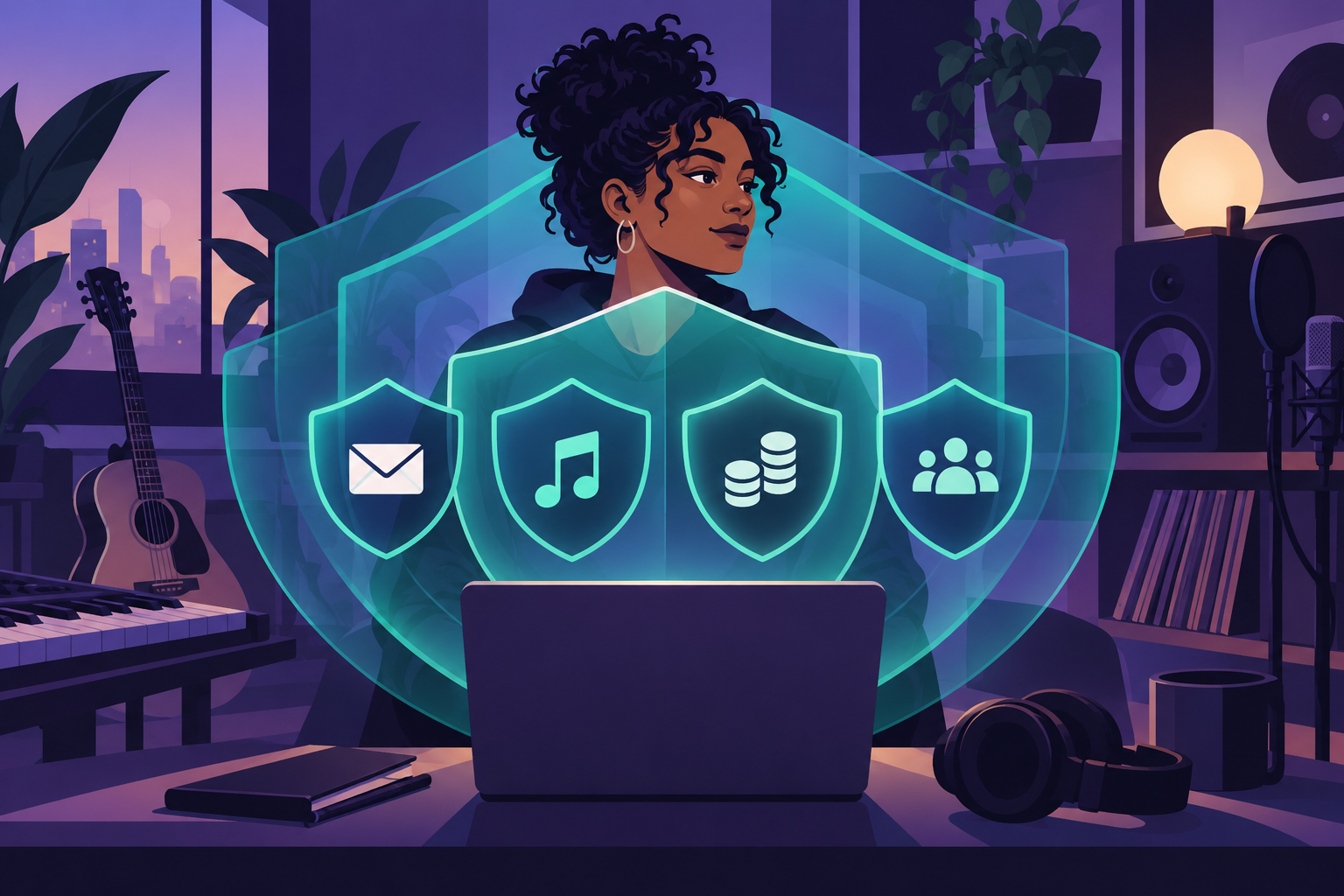
A musician’s most valuable digital asset may not be a master recording. It may be the email address that can reset the password to the distributor, cloud drive, website, social accounts, ad manager and payment platform holding the business together.
That concentration makes artists attractive targets. A convincing direct message can imitate a booking request. A fake copyright notice can pressure someone to sign in immediately. A compromised phone number can intercept text messages intended to restore access.
Account security does not require turning every artist into a cybersecurity specialist. It requires identifying the few accounts that control everything else, strengthening their authentication and deciding what the team will do before an incident creates panic.
Map the Accounts That Could Stop the Career
Begin with an inventory. Include email, mobile carrier, domain registrar, website, distributor, performing-rights organization, cloud storage, social media, advertising, banking, payment processors and password manager.
For each account, record the owner, recovery email or phone, authentication method, backup-code location and every person with access. Do not place passwords inside this inventory. Its purpose is to reveal dependencies.
Look for single points of failure. If one old email address resets eight accounts, it deserves stronger protection. If a former team member still has access to a campaign drive, remove it. If two people share one password through messages, replace the arrangement with individual roles or controlled password sharing.
Protect the Email Account First
Use a unique password for the primary email account and store it in a reputable password manager. Reusing a password across services allows a breach at one platform to become an entry point to another. The Canadian Centre for Cyber Security’s guidance on credential-stuffing attacks explains how stolen username-and-password pairs are tested against other accounts.
Then turn on multi-factor authentication. Prefer a phishing-resistant method where the service supports it, such as a FIDO-based security key or passkey. The Canadian Centre for Cyber Security explains that phishing-resistant MFA uses cryptographic authentication rather than reusable codes that can be intercepted or handed to a fake login page. Its email-security guidance specifically identifies FIDO-based approaches.
An authenticator app is a practical improvement when stronger methods are unavailable. SMS verification is better than a password alone in many situations, but it should not be the first choice for high-value accounts. Canada’s cyber-security authority recommends treating SMS as a low-risk option because codes can be intercepted through SIM swapping, phishing and other social engineering. Its MFA deployment guidance describes the limitation.
Store recovery codes offline in a secure location. Confirm that the recovery address belongs to you and is itself protected. Authentication is only as strong as the easiest recovery path.
Learn the Shape of Music-Industry Phishing
Phishing succeeds by creating urgency and borrowing credibility. A message may claim that a song violated copyright, an account will be disabled, a playlist wants to feature a track, a promoter needs a deposit, or a brand has attached a contract.
Do not sign in through an unexpected link. Open the service through a saved bookmark or type its known address, then check whether the alert appears inside the account. Inspect the sender’s full address, not only the display name. Treat compressed files, unexpected documents and requests to move a conversation to another platform cautiously.
Verify unusual money or access requests through a second channel. If a collaborator asks for a password by email, call the number already stored in your contacts. Do not use the phone number contained in the suspicious message.
Managers and artists should normalize verification. A ten-second confirmation is not distrust; it is a business control.
Reduce SIM-Swap Risk
A SIM swap transfers a victim’s phone number to a threat actor’s SIM or eSIM. The Canadian Centre for Cyber Security notes that attackers may impersonate the customer, steal carrier-account credentials or exploit insider access. Once successful, they can receive communications intended for the victim and use the number to reach other accounts. Its February 16, 2026 SIM guidance provides current details.
Ask the mobile provider which protections are available for number transfers and account changes. Use a unique carrier-account password or PIN, and avoid security questions whose answers can be found in interviews or social posts. Remove the phone number as a recovery method from high-value accounts when a stronger supported option exists.
Warning signs include an unexpected loss of mobile service, password-reset notices you did not request and alerts that authentication settings changed. If service disappears without explanation, contact the carrier from another device promptly.
Give Collaborators the Least Access They Need
Music campaigns routinely involve managers, publicists, designers, advertisers and assistants. Convenience can turn one shared login into a permanent security problem.
Use platform roles where available. Give an advertiser access to the ad account, not the artist’s primary email. Give a designer a project folder, not the entire drive. Set an end date for temporary access and review permissions after every campaign or team change.
Never send backup codes in the same chat that contains the password. Avoid using a personal browser profile on a shared studio computer. Lock devices, install operating-system and browser updates, and encrypt storage where supported.
The same discipline should cover music files. Uranium Waves’ guide to backing up music projects can help protect the creative assets that account security is designed to keep reachable.
Create a 20-Minute Incident Plan
Write a short response order before anything happens:
Secure the primary email from a known-clean device.
Change compromised credentials and revoke unknown sessions.
Contact the mobile carrier if the phone number is affected.
Remove unauthorized app connections, recovery methods and team members.
Notify business partners if fraudulent messages may have been sent.
Preserve screenshots, emails and timestamps for reports or investigations.
Contact financial providers immediately if money or payment data is involved.
Canadians can report cybercrime and fraud through the national Report Cybercrime and Fraud service. Platform-specific recovery should also begin through the official help channel, not an account that appears in unsolicited replies.
Practice the plan once. Confirm that backup codes are accessible and that the team knows who owns recovery. A plan that exists only inside a locked account is not a plan.
Final Takeaway
The strongest security upgrade is not a clever password. It is a layered system: protect email first, use unique credentials, choose phishing-resistant MFA where supported, reduce reliance on SMS, limit collaborator permissions and prepare a recovery sequence.
Artists cannot eliminate every attack. They can make one stolen password or deceptive message far less likely to take down the entire career.
Security should feel like quiet infrastructure. Set it up carefully, review it every few months and return your attention to the music.
Enjoyed the read? Consider showing your support by leaving a tip for the writer
Featured









Follow Us

Shop




















Some attractions arrive like a fever: quiet at first, then suddenly impossible to ignore. Greek-born, Brooklyn-based artist OXFLOYD captures that escalation on “obsessed w u,” an alt-pop single shaped around limerence, romantic fixation, and the dangerous appeal of willingly overlooking every warning sign…