
The Business Tricks Record Labels Don’t Talk About Publicly
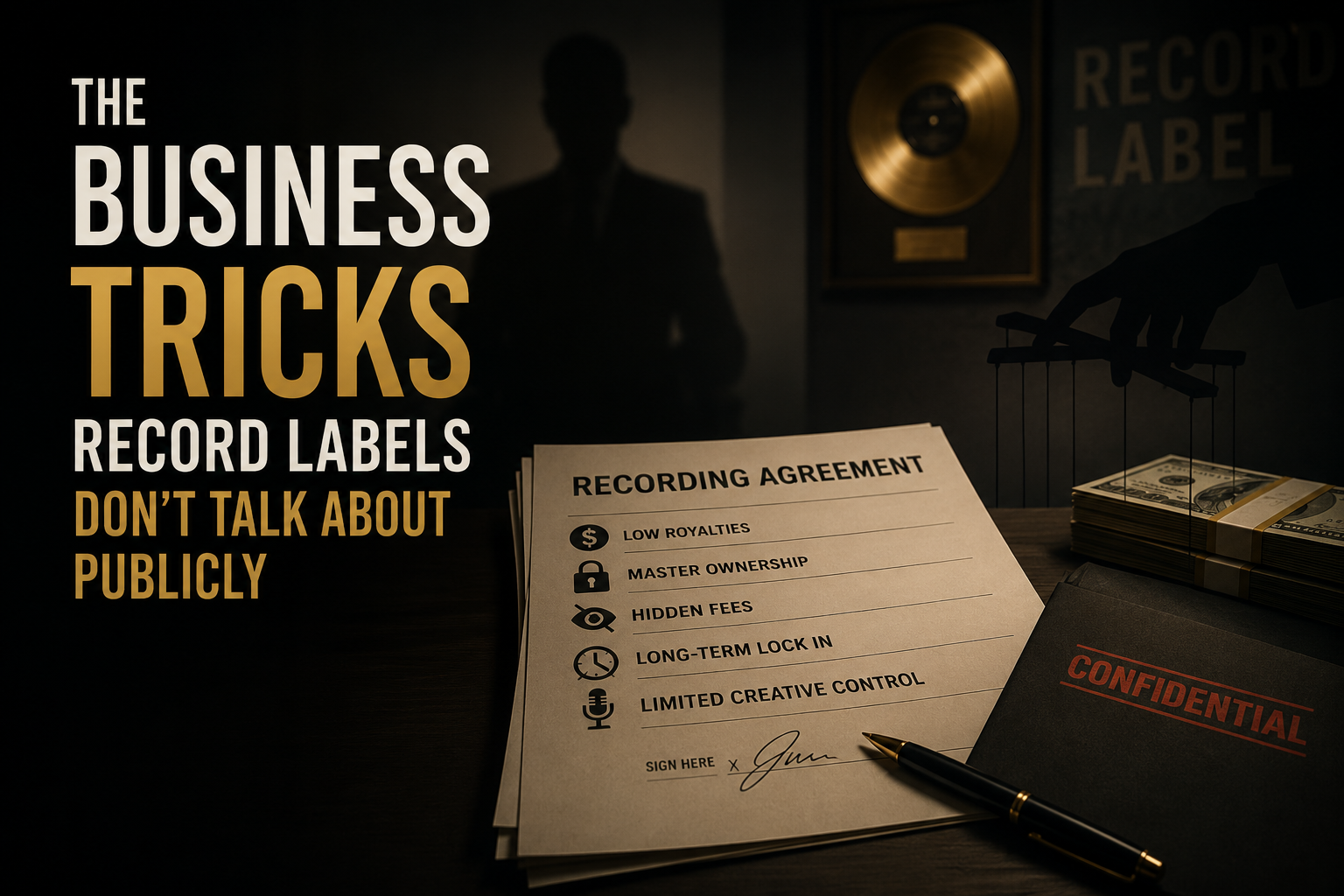
The music industry loves mythology. It loves the sudden discovery, the overnight success story, the mysterious viral moment, the artist who seemingly appears from nowhere with perfect visuals, perfect timing, perfect controversy, and a fanbase that looks already assembled. However, behind many of these polished narratives sits a far more deliberate machine. Record labels do not only sell music. They sell perception, identity, cultural momentum, and commercial inevitability. The public sees the artist. The industry studies the architecture.
One of the least discussed parts of the record label system is the contract itself. To outsiders, a label deal can look like a golden invitation: advance money, studio access, marketing, playlist pitching, public relations, radio strategy, and professional infrastructure. Yet many contracts are built with complex recoupment structures, meaning the artist may receive money upfront but must repay many expenses from future earnings before seeing real profit. Recording costs, video budgets, marketing campaigns, styling, travel, producers, and even certain promotional expenses can often be charged against the artist’s account. In simple terms, the label invests, but the artist may carry much of the financial shadow.
This is why ownership remains one of the most crucial battlegrounds in music. A young artist may sign away master rights without fully understanding how valuable those recordings can become over time. The label knows that a song is not only a release. It is a long-term asset. It can generate income through streaming, licensing, sync placements, compilations, samples, catalogue sales, and future rediscovery. What feels like a career opportunity in the beginning can become a quiet surrender of future leverage if the artist does not understand the fine print.
Then comes image engineering, one of the industry’s most sophisticated tricks. Labels rarely market artists as they are. They refine, exaggerate, soften, sharpen, and package them into something easier to sell. The rebellious artist becomes more rebellious. The mysterious artist becomes almost invisible. The vulnerable singer becomes a confession machine. The glamorous pop act becomes a walking campaign. Hair, wardrobe, interviews, social media tone, photoshoots, music videos, and even public relationships can all become part of a controlled identity system. Authenticity is not always removed; sometimes it is simply edited until it becomes profitable.

Manufactured hype is another quiet mechanism. In public, success is often presented as organic. Behind the scenes, momentum can be carefully staged through influencer seeding, press placements, curated social media clips, fan account activity, strategic controversy, short-form video campaigns, and coordinated release timing. A song may look like it is suddenly everywhere because people naturally discovered it, but in many cases, someone paid, planned, pitched, and pressured that visibility into existence. The goal is to create the impression that the culture has already chosen the artist. Once people believe something is happening, they are more likely to participate in it.
This is where playlist politics enters the conversation. In the streaming era, playlists can function like modern radio gates. Placement on the right editorial playlist, algorithmic lane, or influential third-party list can dramatically affect an artist’s numbers. Labels understand this deeply. They have relationships, data teams, pitching systems, and marketing departments designed to push songs into the right ecosystem. Independent artists are often told that streaming has democratized music, and to some degree, it has. But access is not evenly distributed. Visibility still favours those with infrastructure, connections, budget, and repeated pressure.
The strange part is that none of this necessarily means the artist is fake. Many major-label artists are genuinely talented, hardworking, and creatively serious. The trick is that talent alone is rarely the full explanation. The public might hear a hit song, but the industry sees campaign architecture: audience targeting, brand positioning, release windows, social proof, playlist strategy, public relations, visual identity, and financial risk management. A successful artist is often not just an artist. They are a coordinated commercial project.
Labels also understand scarcity and silence. Sometimes withholding music creates more demand than releasing constantly. Sometimes controversy is not avoided because it keeps the artist visible. Sometimes a mysterious rollout is not confusion but strategy. Sometimes a “leak” benefits the campaign. Sometimes an artist’s sudden reinvention is less spiritual awakening and more market correction. The industry is full of these subtle maneuvers: invisible enough to deny, effective enough to repeat.
For independent artists, the lesson is not to hate labels blindly. The lesson is to understand power. A label can still provide enormous value: funding, reach, industry relationships, professional teams, and global amplification. But artists must know what they are exchanging for that machine. A bad deal can make an artist visible while quietly limiting their freedom. A smart deal can turn label infrastructure into a powerful extension of an artist’s own vision.
The modern music business is not simply about who makes the best song. It is about who controls the story around the song. Contracts decide ownership. Image engineering decides perception. Manufactured hype decides momentum. Playlist politics decides visibility. The artists who survive are not only creative; they are informed. In an industry built on glamour, the most rebellious thing an artist can do is understand the business before the business understands how to use them.
Enjoyed the read? Consider showing your support by leaving a tip for the writer
Featured






Follow Us


Tune in












ALBI. designs “HEARTBEAT” around propulsion. The Brisbane/Meanjin artist layers syncopated synths, distorted bass, and punchy drums into an alt-pop structure that feels engineered for movement, while her crunchy, soaring vocal adds a roughened edge to the song’s otherwise polished momentum. Produced by Song Higginson, the track…