
Streaming Now Makes Up Nearly 70% of Global Recorded Music Revenue
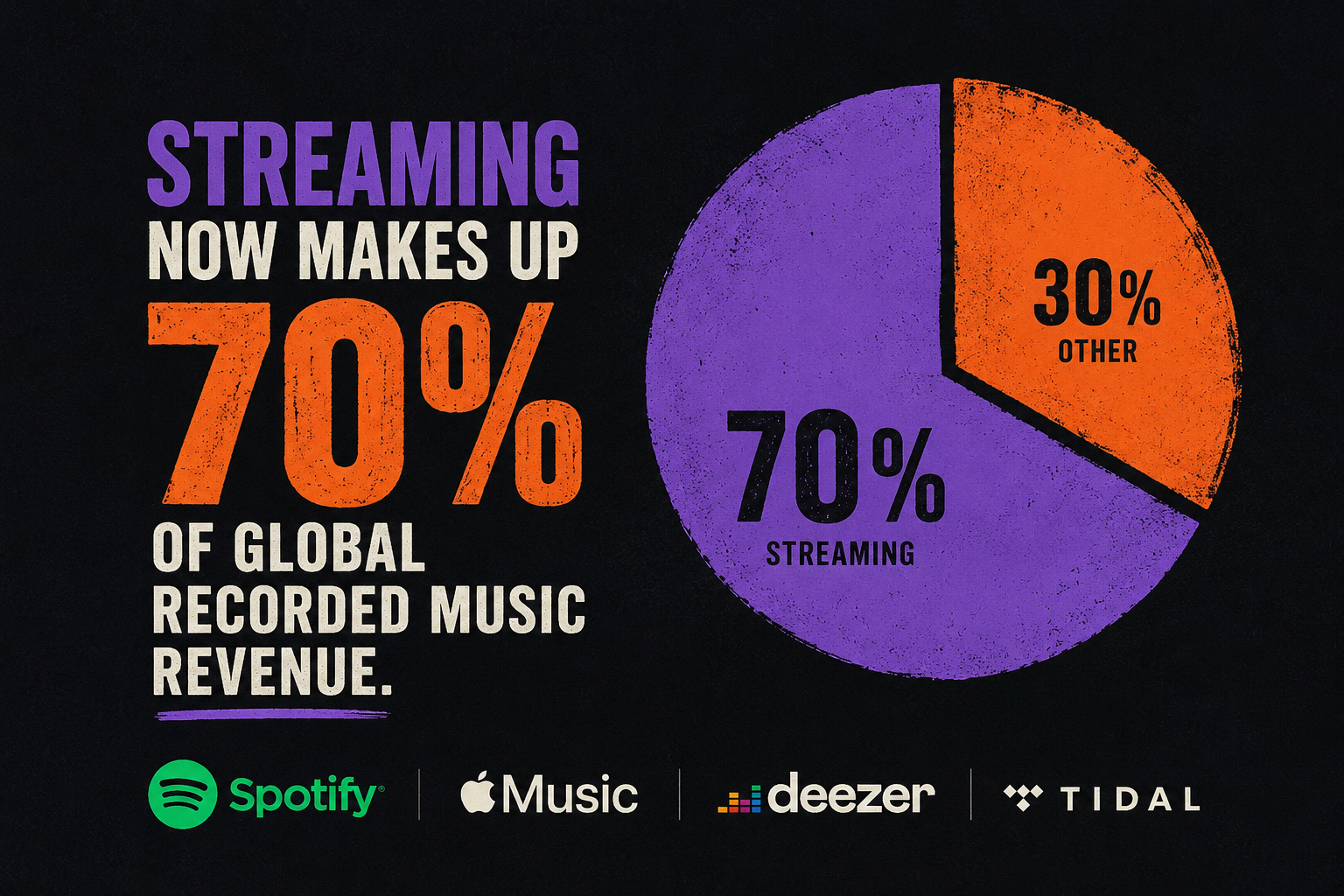
Streaming is no longer just the dominant format in music. It is now the central engine of the global recorded music business. According to IFPI’s latest Global Music Report, worldwide recorded music revenues reached US$31.7 billion in 2025, marking the industry’s eleventh consecutive year of growth. The biggest driver was streaming, which surpassed US$22 billion and accounted for 69.6% of total recorded music revenue. That figure tells a clear story: the modern music industry is now built around access rather than ownership. Listeners are not buying albums in the way previous generations did. They are paying monthly subscriptions, using ad-supported platforms, discovering songs through playlists, and moving between catalogues with almost no friction. For labels, distributors, artists, publishers, and managers, that shift has changed nearly every part of the business.
The most important detail is not simply that streaming is large. It is that paid subscription streaming now represents more than half of all recorded music revenue worldwide. IFPI reported that paid subscription streaming grew 8.8% in 2025 and accounted for 52.4% of global revenue. The number of paid subscription users also rose to 837 million, showing that the subscription model still has room to expand across global markets. This growth confirms that streaming has become the industry’s baseline economy. Physical sales, downloads, performance rights, and sync licensing still matter, but they now orbit around streaming rather than compete with it as the main commercial centre. For most artists, especially independent artists, streaming platforms are no longer optional. They are the primary public storefront for music discovery, catalogue value, fan behaviour, and long-term income.
The numbers also reveal how global the business has become. Streaming is not only powering revenue in North America and Europe. It is helping expand recorded music income in Latin America, the Middle East, North Africa, Sub-Saharan Africa, and parts of Asia, where mobile-first listening habits have made digital access essential. In many markets, streaming skipped over older ownership models and became the first truly scalable music format. For major labels, the nearly 70% streaming share reinforces the value of catalogue control. Older hits, viral rediscoveries, playlist placements, and algorithmic resurfacing can continue generating revenue years after release. A song no longer needs to be new to be commercially active. If it lands in the right playlist, TikTok trend, film scene, or fan community, it can re-enter the revenue cycle almost instantly.

For independent artists, the picture is more complicated. Streaming gives artists global distribution at a scale that would have been impossible in the CD era. A bedroom artist in Montréal, Lagos, Seoul, London, or São Paulo can upload a song and technically reach listeners worldwide. That access is powerful. But access does not automatically create income. With millions of tracks competing for attention, discovery has become the real battle. That is why streaming success in 2026 depends on more than simply releasing music. Artists need strategy: consistent singles, strong visuals, playlist pitching, short-form video, fan engagement, metadata accuracy, email lists, live performance, and direct-to-fan monetization. Streaming can introduce people to the music, but it rarely builds a sustainable career by itself unless the artist has a broader ecosystem around the songs.
The nearly 70% figure also raises questions about artist compensation. Global streaming revenue is growing, but many artists still feel that the money does not flow down evenly. The structure of streaming payouts depends on rights ownership, label deals, distributor terms, publishing splits, market rates, platform models, and listener location. A billion-dollar streaming economy does not mean every artist is earning enough to live from streams. This tension is one of the defining contradictions of the modern music business. Streaming has helped rescue recorded music from the collapse of the download and piracy era, yet it has also created a system where scale matters enormously. Superstars, major labels, catalogue owners, and high-volume rights holders benefit the most. Smaller artists often need to convert streaming attention into other income: merch, tickets, sync licensing, fan subscriptions, services, brand partnerships, and crowdfunding.
Another major issue is fraud. As streaming becomes the industry’s financial centre, it also becomes a target for manipulation. Fake streams, bot activity, artificial playlisting, and low-quality mass uploads can divert money away from legitimate artists. IFPI has emphasized that streaming fraud and AI-related abuse will be key challenges for the next era of the music business. That concern is likely to grow as generative AI tools make it easier to flood platforms with synthetic tracks. Still, the overall growth is significant. Recorded music reaching US$31.7 billion shows that the global market remains resilient. Streaming has created a recurring revenue model that gives the industry more stability than one-off purchases ever could. Monthly subscriptions create predictable income. Ad-supported listening expands reach. Global licensing deals help platforms operate across borders. For labels and distributors, that model is commercially attractive because it turns music into a continuous service rather than a single transaction.
For fans, the shift has made music more available than ever. A listener can move from a new Afrobeats single to a 1970s soul album, a Japanese city pop playlist, an underground Canadian R&B release, and a viral German song within minutes. That abundance has changed taste itself. Genres now travel faster, regional scenes become global quicker, and songs can explode outside their home markets without traditional radio leading the way. The challenge is that abundance can also make music feel disposable. When listeners have access to nearly everything, individual songs can become easier to skip, forget, or replace. That puts pressure on artists to create not only good songs, but memorable worlds around those songs. In the streaming era, music competes with music, but also with video, gaming, podcasts, social media, and every other form of attention.
The takeaway is simple: streaming is no longer the future of recorded music. It is the present infrastructure. With nearly 70% of global revenue now coming from streaming, every serious artist, label, and music entrepreneur has to understand how the system works. That means knowing how songs are discovered, how royalties flow, how playlists influence behaviour, how platforms reward engagement, and how to turn passive listeners into actual fans. Streaming has made the music industry larger, faster, and more global. It has also made it more competitive, more data-driven, and more dependent on attention economics. The artists who thrive in this environment will not be the ones who simply upload songs and hope. They will be the ones who treat streaming as one part of a larger career system.
The global recorded music business is growing, and streaming is carrying most of that weight. The next question is not whether streaming will dominate. It already does. The real question is how the industry will make that dominance fairer, cleaner, and more sustainable for the artists whose music keeps the entire machine alive.
Enjoyed the read? Consider showing your support by leaving a tip for the writer
Featured









Follow Us

Shop




















A breakup can look like rain on a window, but sometimes it looks like taking a trash bag to the curb with lipstick still on. Kirrilee’s “Go Away (Garbage Tip)” brings the Australian artist into a cheeky Alt Pop frame, where bad dating memories are not mourned so much as theatrically…